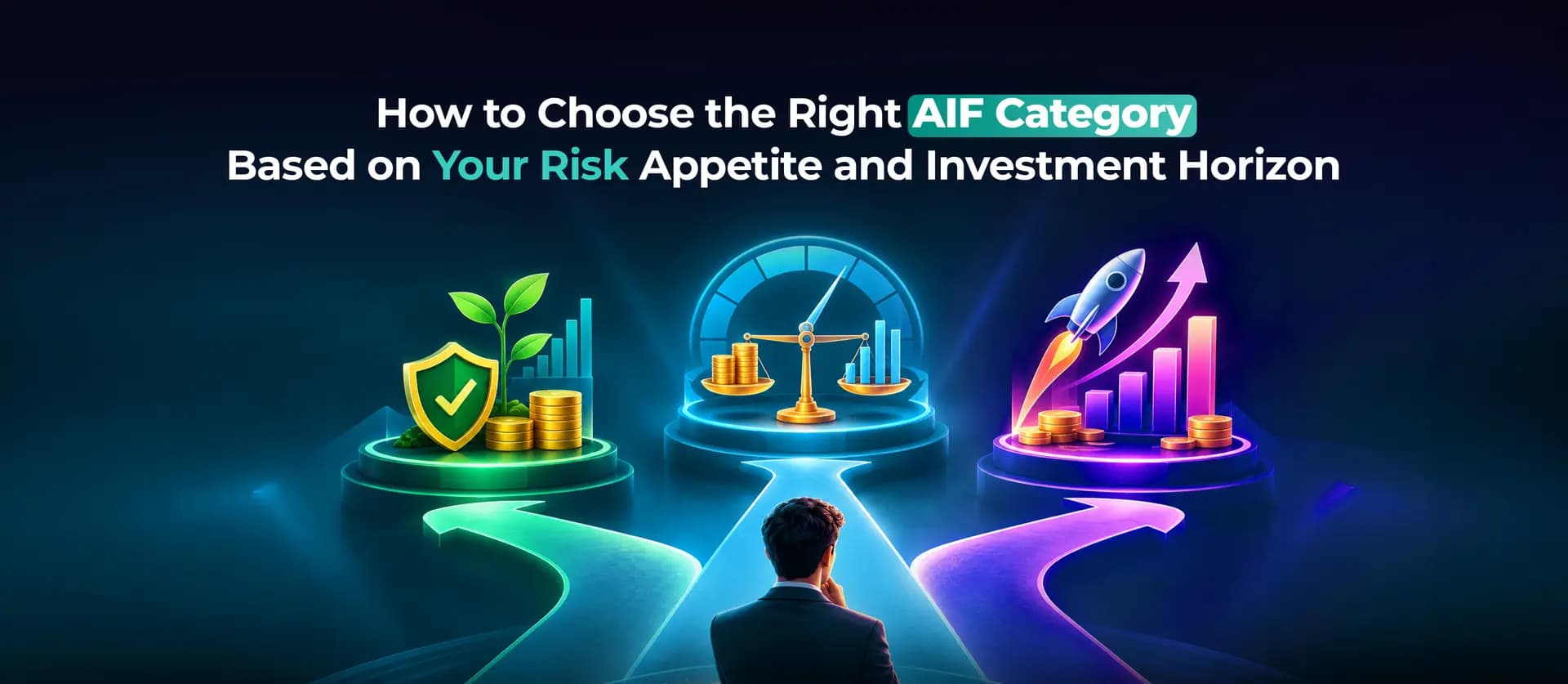
Before comparing categories, most investors should be asking two questions honestly: how many years can this capital sit untouched without disrupting my life, and how would I actually react if this investment showed a 20% markdown for eighteen months straight? The categories differ enormously on both counts, and the right answer isn't the one that sounds most sophisticated at a dinner party — it's the one that matches your actual balance sheet.
Category I AIFs — venture capital, SME funds, infrastructure funds, social venture funds, and angel funds — exist because SEBI wants to channel private capital into businesses that matter for India's long-term growth story. That mandate shapes everything about how these funds behave. Capital goes into early-stage or growth companies, infrastructure projects, or SMEs that are years away from a liquidity event, if one arrives at all.
This is patient capital in the truest sense. Lock-ins commonly run seven to ten years, illiquidity is total until an exit event occurs, and a meaningful share of underlying investments simply won't work out — venture-style return distributions mean a small number of winners carry the portfolio. If that variance makes you uneasy, or if there's any realistic chance you'll need this capital back within the decade, Category I isn't the right seat for you regardless of how compelling the pitch sounds.
Where it does make sense: investors who already have their core financial goals funded through other means, who are allocating a genuinely discretionary slice of net worth, and who have the temperament to watch a portfolio company's valuation swing wildly without needing to act on it. Family offices and HNIs building a long-horizon private markets sleeve are the natural audience here.
Category II is where the bulk of India's AIF capital lives, and for good reason. This category covers private equity, private debt, real estate funds, and funds of funds — vehicles that buy into established, cash-generating businesses or lend against real assets, rather than betting on unproven startups. Leverage is essentially off the table except for short-term operational needs, which keeps the risk profile meaningfully more contained than what you'll find in Category III.
The horizon is still real — a minimum three-year tenure is standard, and closed-ended structures mean your capital is locked until the fund exits its positions through IPOs, strategic sales, or refinancing. But the return path tends to be steadier. Private credit funds within this category, in particular, offer a defined coupon-like return profile that suits investors who want private markets exposure without the binary outcomes of venture investing.
This category tends to fit investors with a five-to-seven-year horizon who want genuine diversification away from listed equity and debt, but who aren't comfortable with the all-or-nothing dynamics of early-stage investing. If your goal is compounding wealth steadily over the medium-to-long term without wild drawdowns, Category II usually deserves the first look.
Category III AIFs — hedge funds and PIPE (Private Investment in Public Equity) funds — are the only category permitted to use leverage and derivatives, and the only one that can be open-ended, meaning some structures offer periodic liquidity rather than a hard lock-in. That flexibility comes at a cost: these funds are taxed at the fund level at a rate that erodes post-tax returns meaningfully compared to the pass-through treatment of Category I and II.
This category suits a narrower investor profile — typically someone who already runs a PMS mandate or has direct market exposure, understands strategy-level risk (long-short, arbitrage, event-driven, tactical allocation), and wants an additional layer of active, market-linked return on top of an existing portfolio. Volatility here can be sharper and faster than in Category I or II, but the tradeoff is comparatively better liquidity and a shorter effective horizon for investors who pick open-ended structures. The risk in Category III can show up faster. Because these funds may actively trade listed securities and use derivatives or leverage, their NAV can respond quickly to market movements and strategy-level events. This does not necessarily make every Category III fund riskier than every Category I or II fund—it means the nature and timing of the risk can be different.
If you're newer to alternative investments, or if tax efficiency is a priority, Category III is rarely the starting point. It tends to work best as an addition once the rest of the portfolio is already established.
A useful way to think about this: your investment horizon should set the outer boundary of what's even possible, and your risk appetite should decide where within that boundary you sit.
An investor with a ten-year-plus horizon and genuine tolerance for binary outcomes has Category I on the table, alongside II and III. An investor with a five-to-seven-year horizon and a preference for steadier compounding is generally better served by Category II. An investor who wants exposure that can flex with shorter horizons, who already understands market-linked strategies, and who is comfortable with fund-level taxation, is the right candidate for Category III.
What doesn't work is reverse-engineering the decision from expected returns alone. A Category I venture fund advertising a high target IRR isn't a better choice than a Category II private credit fund with a lower but far more predictable return, if your actual need is capital preservation with modest growth over five years. The category has to fit the investor first; the return profile is a consequence of that fit, not the reason for it.
Whichever category you're leaning toward, read the Private Placement Memorandum closely — it discloses the fund's actual strategy, fee structure, and risk factors in far more detail than any marketing deck. Look at the fund manager's track record within that specific category, not just their general market reputation, since venture, private equity, and hedge-fund strategies require genuinely different skill sets. And be honest about the lock-in: a three-year or seven-year tenure isn't a formality, it's the defining feature of the instrument you're buying.
Getting the category right is the single most consequential decision in AIF investing — more consequential, in most cases, than picking between two funds within the same category. Get the fit right first, and the fund selection that follows becomes a much easier conversation.
0

33

0
Publish Date
18 Aug 2026
Reading Time
6 mins
Last Updated
16 Sep 2026
Social Presence


Table Of Content
